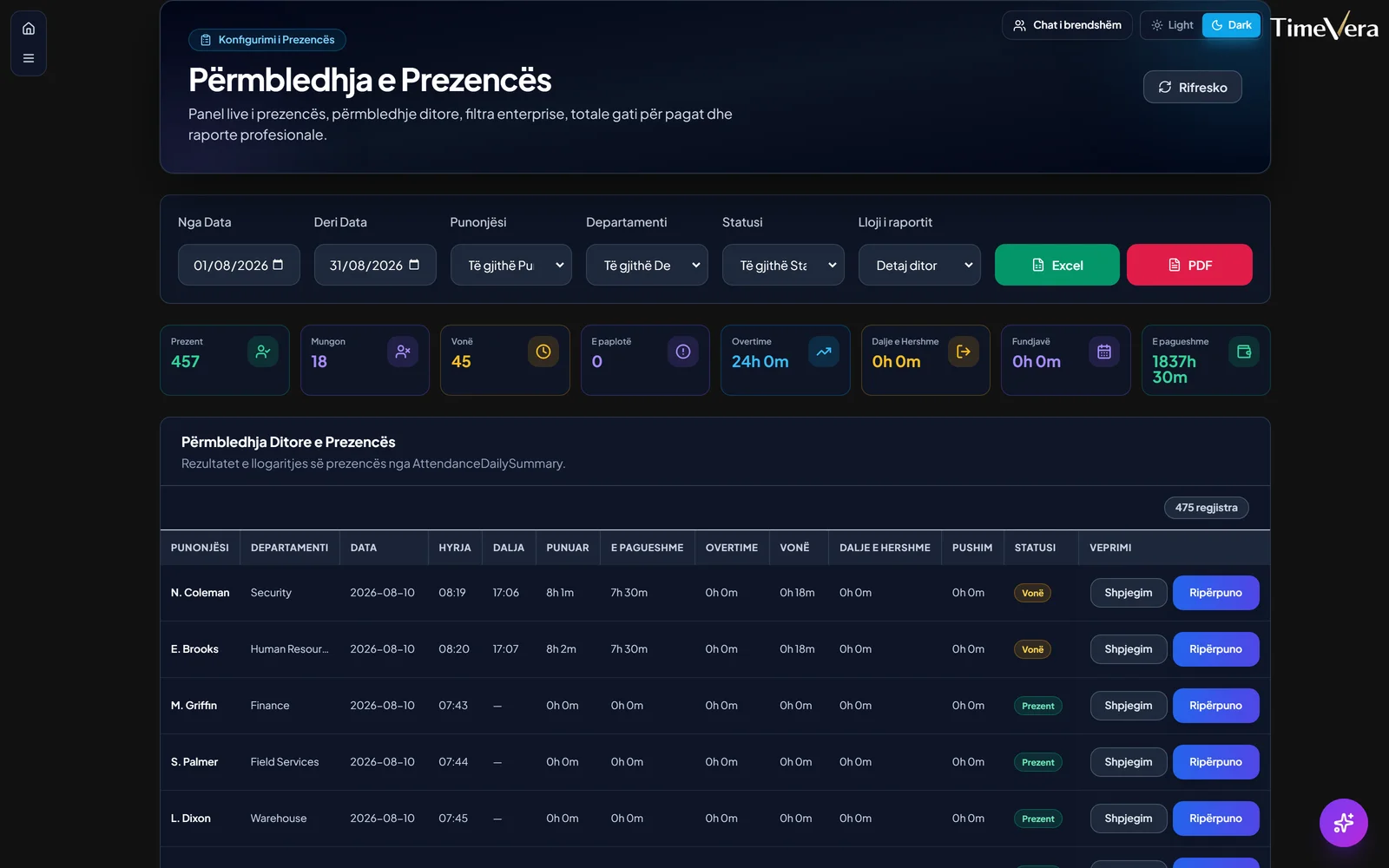
What Is an Employee Attendance Management System?
An employee attendance management system records when people start and end work, applies company rules, and turns those events into reliable data for managers, HR and payroll preparation.
An employee attendance management system is software that records when employees start and end work, organizes those events into daily attendance records, and gives managers, HR and payroll teams a reliable view of presence, lateness, overtime and absences.
In plain terms: it turns “who worked when?” into structured data instead of paper timesheets, chat messages or end-of-month Excel reconstructions.
How does an attendance management system work?
A typical workflow looks like this:
- An employee creates an attendance event (clock-in or clock-out) at a biometric terminal, from a mobile app, or through another approved capture method.
- The system stores the event with a timestamp and links it to the correct employee record.
- Company rules and schedules are applied — shifts, grace periods, overtime thresholds and related exceptions.
- The result becomes an attendance record for the day (present, late, overtime, absent, and similar statuses).
- Managers use live or daily views and reports; approved working time can support payroll preparation.
The important idea is not the device brand. It is the chain: employee → attendance event → rules/schedule → attendance record → reporting and payroll workflow.
What information can attendance software manage?
Useful attendance software usually helps teams manage:
- Clock-in and clock-out events
- Presence during the working day
- Lateness and early leave
- Overtime
- Absences
- Shift and schedule context
- Department or site-level visibility for managers
- Exports and reports for operations and payroll preparation
It does not replace every HR process by itself. It is the time layer that other workforce processes depend on.
Manual attendance vs automated attendance
| Manual Attendance | Automated Attendance |
|---|---|
| Delayed visibility — problems often appear at month-end | Faster day-to-day visibility of who is present |
| Disputes about who arrived when | Clearer event timestamps linked to employees |
| Extra work rebuilding hours before payroll | Less retyping of hours into spreadsheets |
| Inconsistent records across sites | Shared attendance records in one system |
| Guesswork during the working day | Managers can review exceptions earlier |
Automation still needs clear ownership: someone must maintain employee records, schedules and device/mobile setup.
What are the benefits?
The real benefits are operational, not decorative:
- Less manual administration for supervisors and HR
- More consistent attendance records
- Faster visibility into who is present, late or absent
- Clearer overtime, lateness and absence analysis
- Cleaner inputs for payroll preparation
- Better control when people work across multiple sites or teams
If a product only shows a punch list without rules, reporting and managerial visibility, it is only half of an attendance system.
Attendance devices and biometric systems
Many companies capture attendance with biometric terminals (fingerprint or face recognition) or other attendance terminals. The device verifies the person at the door and creates a punch event. Cloud software then stores and processes that event.
Biometrics are useful when identity assurance matters. They are not mandatory for every company. Some teams use mobile check-in for field staff, terminals for factory or office entrances, or a mix.
What matters for business value is synchronization: punches should reach the attendance system reliably, with employees correctly mapped, so managers do not collect USB logs or rebuild days by hand.
Attendance and HR
Attendance answers: “Was this person working / present according to the rules?”
HR answers: “Who is this employee, under which contract, department and employment status?”
In a connected workforce platform, the useful chain is:
Attendance → Employee records → Leave → Scheduling → Payroll preparation
Attendance should use the same employee master as HR. Leave remains a related process (requests, approvals, balances). Scheduling defines who should work when. Payroll uses approved hours and company pay rules. Keeping these areas connected reduces handoffs and month-end rework.
Managing multiple locations
A practical example: a retail or security company with several sites needs one place to see presence across teams — not a separate spreadsheet per location.
In that setup, attendance events may come from different terminals or mobile check-ins. Managers still need a shared view of lateness, absences and overtime. Multi-location management fails when each site keeps private records and payroll receives conflicting files.
How TimeVera approaches attendance management
TimeVera is built as cloud workforce software where attendance is a core module — not an isolated punch archive.
In TimeVera, attendance events can come from compatible biometric attendance devices and from mobile check-in workflows. The platform applies schedule/attendance rules, supports live presence visibility for managers, and produces attendance overviews and report exports. Approved working time can feed payroll preparation when payroll is configured for the company. HR, leave and scheduling live in the same platform so people data and time data stay connected.
TimeVera does not claim that biometric hardware is required for every customer. Device model fit and network setup are confirmed during implementation.
Explore next
FAQ
What is an employee attendance management system?
It is software that records working time and presence events, applies company rules, and turns those events into attendance records managers, HR and payroll teams can use.
Is biometric hardware required?
No. Biometric terminals help when identity assurance at the entrance matters. Many teams use mobile check-in, terminals, or a mix.
Can attendance data be used for payroll?
That is a core reason companies adopt attendance software. In TimeVera, approved working time is designed to support payroll preparation instead of being retyped from paper or Excel.
Does attendance software replace HR software?
No. Attendance focuses on time and presence. HR focuses on employee records and employment processes. TimeVera includes both so they stay connected.
Can one system support multiple locations?
Yes — that is a common reason to leave spreadsheets. TimeVera is used by teams that need presence and attendance visibility across sites and departments from one cloud platform.
What is the difference between attendance and leave?
Attendance records whether someone was present according to working-time rules. Leave manages approved time away from work (requests, approvals and balances). They are related processes, not the same thing.
How do managers use attendance data day to day?
They review who is present, late or absent, investigate exceptions, and use reports before payroll closes — instead of discovering problems only at month-end.
Request a Demo · Related solution · All resources · Devices · Menaxhim orari · Time & Attendance